
What if a stock losing money could actually improve your financial plan?
Most investors see a declining investment as bad news.
But in a taxable portfolio, some losses can become valuable tax assets—helping offset capital gains, diversify concentrated stock, and potentially keep more money invested.
That’s one of the ideas behind direct indexing.
First, what is direct indexing?
Most investors get broad stock-market exposure by buying an ETF or mutual fund.
Buy one fund and you might own hundreds—or even thousands—of companies.
Direct indexing takes a different approach.
Instead of owning the fund, you directly own many of the individual stocks that make up the index.
The objective can be very similar: broadly diversify and track a particular market.
But owning the individual stocks gives you something an ETF can’t:
More control over the individual pieces.
That creates more opportunities to manage taxes, customize what you own, and work around existing concentrated stock positions.
For example, a broad U.S. direct index can seek exposure to thousands of U.S. companies while using a smaller sample of individual stocks designed to closely track the broader market.
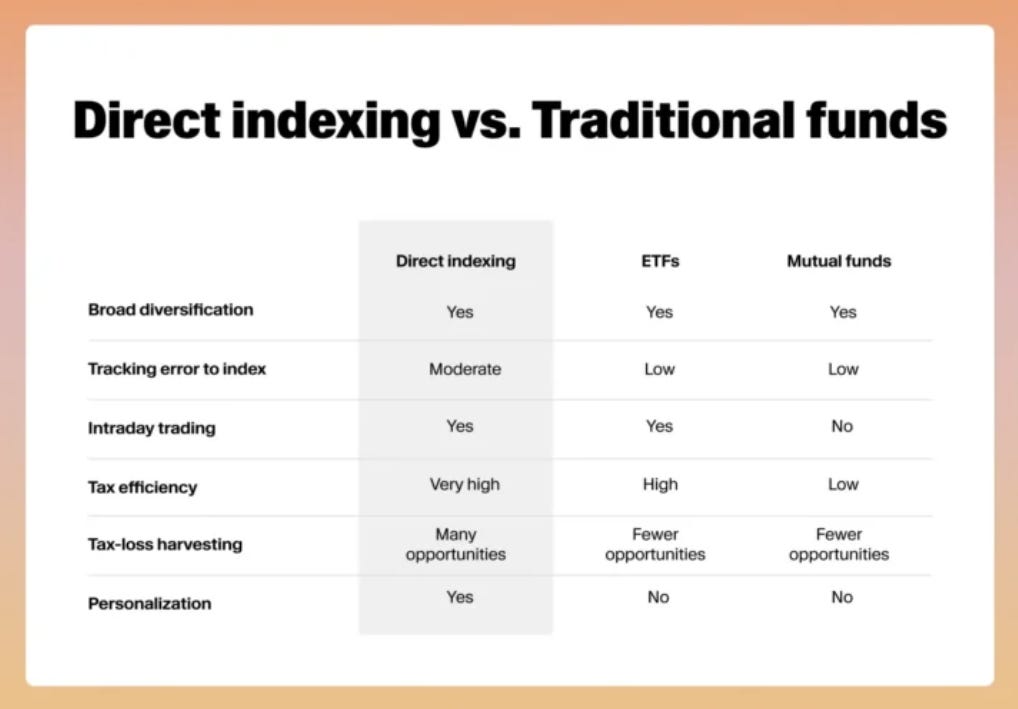
Both approaches can provide broad diversification.
The important difference is what you own.
An ETF gives you shares of one fund.
Direct indexing gives you ownership of many individual securities.
And that’s where the tax opportunity begins.
You can make money and still have losses
Imagine investing $2 million into a diversified portfolio.
A year later, the portfolio is up $150,000.
Good year.
But underneath that overall return, individual stocks moved in different directions.
For simplicity:
Stocks that gained: +$350,000
Stocks that declined: -$200,000
Overall portfolio: +$150,000
If you owned an ETF that was worth more than you paid for it, you generally wouldn’t have a loss in that ETF position to harvest.
With direct indexing, you own the individual stocks.
Some of those individual losing positions could potentially be sold and replaced with other investments to maintain similar market exposure while navigating the wash-sale rules.
So you can potentially harvest tax losses even though your overall portfolio made money.
What could a $200,000 loss actually be worth?
This is where the numbers get interesting.
Suppose our investor has $200,000 of long-term capital gains they would like to realize elsewhere.
Maybe they’re selling appreciated company stock. Maybe they’re rebalancing another portfolio. Or perhaps they’re dealing with another liquidity event.
The direct-index portfolio generates:
$200,000 of harvested losses
Those losses are used to offset:
$200,000 of realized long-term gains
At a hypothetical 23.8% federal long-term capital-gains rate:
$200,000 × 23.8% = $47,600
That’s potentially $47,600 of federal tax deferred today.
State taxes could increase the current-year benefit depending on where the investor lives.
And instead of sending that money toward taxes today, those dollars can potentially remain invested.
Where this gets particularly useful: concentrated stock
Now consider an executive with $5 million of highly appreciated company stock.
They know they should diversify.
But selling the stock creates a large capital-gains tax bill.
So they face a familiar conflict:
Investment risk says diversify.
Taxes say don’t sell.
Direct indexing can potentially provide another option.
Suppose a diversified direct-index portfolio generates $200,000 of harvested losses.
Those losses could potentially be paired with gains from gradually selling the concentrated stock:
Harvest $200,000 of losses
↓
Realize $200,000 of gains from company stock
↓
Use losses to offset gains
↓
Reinvest the proceeds into a more diversified portfolio
Over time, the investor can potentially reduce the concentrated position while managing the tax consequences along the way.
Direct indexing can also be constructed around existing appreciated holdings rather than blindly adding more exposure to securities an investor already owns.
What tax management can look like in practice
The tax benefit isn’t limited to harvesting losses.
Technology can also help manage when gains are realized, whether gains are short- or long-term, and how losses are coordinated with the rest of the portfolio.
Here’s an illustrative example from Altruist showing how its Tax Management Report tracks several different sources of estimated tax savings.
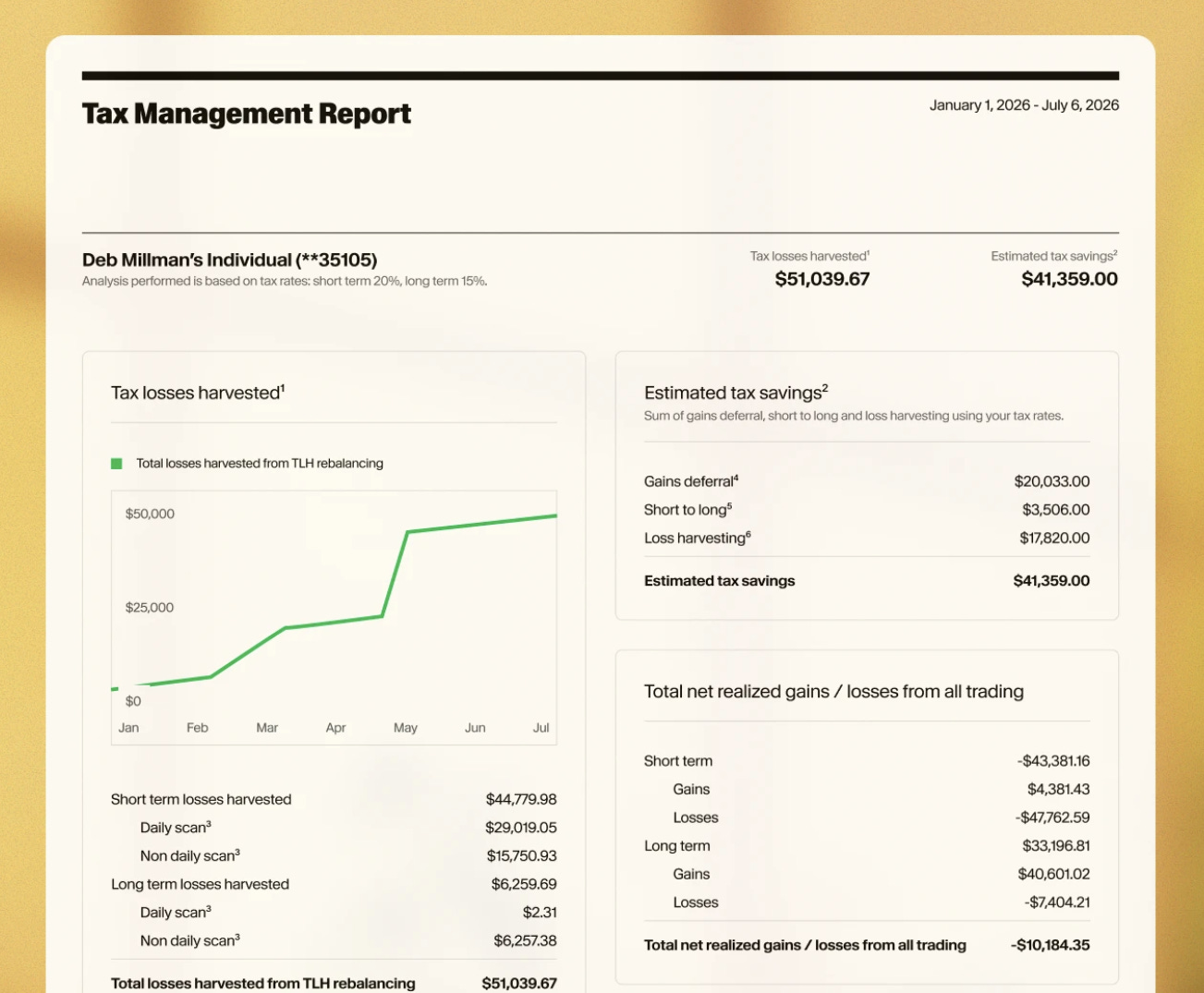
What I find most interesting about this example isn’t simply the $51,039.67 of tax losses harvested.
The illustration shows $41,359 of estimated tax savings coming from three different areas:
Gains deferral: $20,033
Short-term to long-term: $3,506
Loss harvesting: $17,820
That’s an important distinction.
Good tax management isn’t simply about generating the largest possible number of losses. It’s about making better decisions with those losses.
But there’s a catch
Tax-loss harvesting doesn’t magically make taxes disappear.
Suppose you bought an investment for $100.
It falls to $70.
You sell it, realize the $30 loss, and purchase an appropriate replacement investment.
You now have a $30 tax loss.
But the replacement investment starts with a new, lower cost basis.
If it subsequently appreciates and is eventually sold, you may have a larger taxable gain waiting for you.
That’s why tax-loss harvesting is frequently tax deferral—not necessarily tax elimination.
And that distinction matters.
So what happens to the deferred tax?
Sometimes you eventually sell the investment and pay the tax.
But not always.
An investor may carry losses forward and use them against future gains.
Appreciated securities might eventually be donated to charity.
Or, under current tax law, appreciated investments held until death may receive a step-up in cost basis.
So the eventual outcome could look very different depending on the investor:
Pay the tax later → defer it for years → offset other gains → donate the appreciated asset → potentially receive a basis adjustment at death.
This is where investment management and financial planning start to overlap.
Direct indexing isn’t automatically better
There are tradeoffs.
Direct indexing is more complex than simply owning an ETF. Tax-loss harvesting and customization can introduce tracking error. Harvesting opportunities may become less plentiful as a portfolio ages and develops larger embedded gains.
And the tax benefits primarily matter in taxable accounts.
An IRA or 401(k) doesn’t receive the same benefit from harvesting investment losses.
Most importantly, a direct-index portfolio isn’t guaranteed to generate enough losses to produce meaningful tax benefits. The strategy isn’t appropriate for every investor.
The real value isn’t the loss
It’s easy to see a report showing $100,000 or $200,000 of harvested losses and assume that’s the value created.
It isn’t.
A $200,000 tax loss isn’t worth $200,000.
Its value depends on your tax rate, the gains those losses offset, when those gains otherwise would have been realized, how long the tax can be deferred, what happens to the replacement investments, and how everything fits into your broader financial plan.
Which is why the better question isn’t:
“How much can I harvest?”
It’s:
“What am I going to do with the losses?”
For the right investor, direct indexing can turn something most investors dislike—a declining stock—into a useful tax-planning asset.
And when those losses are coordinated with concentrated stock, portfolio transitions, charitable giving, and a long-term financial plan, tax management becomes part of the investment strategy rather than something you think about every April.
Could direct indexing make sense for you?
Direct indexing isn’t right for everyone. Its value depends on your portfolio, tax situation, existing capital gains, concentrated stock positions, and long-term financial plan.
If you have significant taxable investments or highly appreciated stock, the more useful question isn’t whether direct indexing works—it’s what the opportunity might look like with your own portfolio and tax situation.
If you’d like to explore it, reach out. We can evaluate your existing holdings and help quantify where tax-loss harvesting and personalized direct indexing may or may not—add value for you.