
A quick note before we get started
You may have noticed a new name at the top of this email.
Smarter with Money is now Brian Talks Money.
The name is changing (again), but the idea behind it isn’t: one good financial decision today compounds into a better life tomorrow.
I want this to be a place where we can talk plainly about money: investing, taxes, retirement, estate planning, insurance, and the financial decisions that come up in real life.
I’ll also be taking Brian Talks Money beyond the newsletter with short, practical financial education videos. Stay tuned. Now, let’s talk interest rates.
We spent decades getting used to cheap money.
For much of the past 20+ years, falling or unusually low interest rates became part of the financial backdrop.
Then look at where we are today.
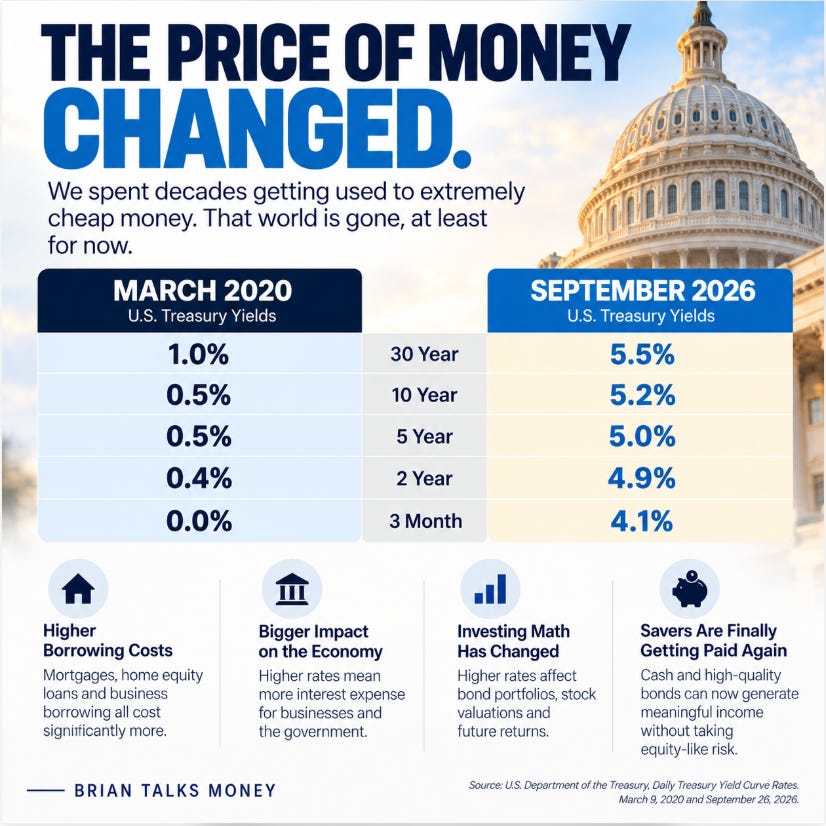
In March 2020, the 10-year Treasury yielded roughly 0.5%.
Today, it’s around 5.2%.
The 30-year Treasury went from roughly 1% to 5.5%.
That’s not a small adjustment.
The price of money has fundamentally changed.
And that affects almost every financial decision we make.
Borrowing got expensive
This is the part everyone feels.
Consider a $1 million, 30-year mortgage:
At 3%: about $4,200/month
At 7%: about $6,650/month
Same house. Same loan.
About $2,450 more every month, or nearly $30,000 more per year, just to finance the same house.
And it isn’t just mortgages. Higher rates affect home equity loans, business financing, commercial real estate, auto loans and corporate borrowing.
Cheap money made a lot of financial decisions easier.
Expensive money forces us to actually do the math.
But savers finally have an alternative
Here’s the other side of the story.
For years, investors essentially had two choices: accept almost nothing on safe money or take more risk.
That’s changed.
Treasuries, high-quality bonds and cash alternatives can now generate meaningful income.
Consider $1 million.
At a 1% yield, that’s roughly $10,000 a year.
At 5%, it’s $50,000.
That’s a very different retirement-income conversation.
For some investors, especially those approaching or already in retirement, higher rates have actually improved the planning environment.
The investing math changed too
When safe assets yielded almost nothing, investors had a powerful incentive to move further out on the risk spectrum.
Stocks. Real estate. Private investments. Growth companies.
Today, an investor can earn around 5% on certain high-quality fixed-income investments. That creates a much higher hurdle.
If you’re going to take significantly more risk, you should expect to be compensated for taking it.
It doesn’t mean stocks suddenly become unattractive. It means the comparison has changed.
And portfolios designed for a near-zero-rate world may deserve another look.
And then there’s the Fed
Here’s where things get interesting.
The Federal Reserve is facing an uncomfortable tradeoff.
Keep rates high?
That can help contain inflation. But higher rates also make mortgages and business loans more expensive, put pressure on housing and the economy, and contribute to rising interest expense as government debt is refinanced.Cut rates?
That provides relief to borrowers and can stimulate the economy. But cut too aggressively while inflation remains elevated, and the Fed risks reigniting the very problem it’s been trying to solve.
That’s the dilemma.
Higher rates help fight inflation, but make an already expensive debt problem more expensive.
Lower rates provide relief, but risk making the inflation problem harder to solve.
There isn’t an obvious answer. And there’s another wrinkle.
The Fed doesn’t control the rate that matters to your mortgage
This distinction gets lost all the time.
When you hear that “the Fed cut rates,” that doesn’t mean your mortgage rate automatically falls by the same amount.
The Fed directly controls a very short-term interest rate.
Longer-term Treasury yields are determined by the bond market and influenced by things like inflation expectations, economic growth, government borrowing and investor demand.
Those longer-term rates matter enormously for mortgages and other borrowing costs.
So the Fed can cut short-term rates while the 10-year Treasury stays above 5%.
That’s important because waiting for the Fed to “fix” borrowing costs isn’t much of a financial strategy.
Don’t build a financial plan that requires rates to fall
Maybe rates fall substantially from here.
Maybe inflation cools and we eventually return to a lower-rate environment.
Or maybe the ultra-low interest rates of the 2010s were the unusual period.
Nobody knows.
A good financial plan shouldn’t require us to know.
Instead, today’s rate environment creates some very practical questions:
Is excess cash still sitting in a bank account earning almost nothing?
Does your bond allocation make more sense today than it did five years ago?
Should you pay down debt or invest?
Does buying a second home still make sense at today’s borrowing costs?
Can higher bond yields improve your retirement-income plan?
Should you refinance debt if rates eventually decline?
Does your portfolio still need to take as much risk as it once did?
Those are planning questions.
And they’re much more useful than trying to predict the Fed’s next move.
The bottom line
A 5% Treasury yield isn’t inherently good or bad.
It’s expensive if you’re borrowing.
It’s attractive if you’re saving or lending.
It changes asset valuations, retirement-income planning and the hurdle for taking investment risk.
And it changes decisions around everything from buying a house to building a portfolio.
The important question isn’t: “When will rates go back down?”
It’s: “What should I be doing differently if they don’t?”
That is a much better question to build a financial plan around.
Source: U.S. Department of the Treasury, Daily Treasury Par Yield Curve Rates, March 2020 and September 2026. Treasury yields fluctuate daily. For educational purposes only.