
By the time you file your tax return, many of your best opportunities to change it are already gone.
You can still report everything correctly. But you generally can’t go back to December and undo a stock sale, complete a Roth conversion or make a charitable gift for the prior year.
The checklist below highlights 10 tax moves to review before December 31. Some depend on your age. All depend on your circumstances.
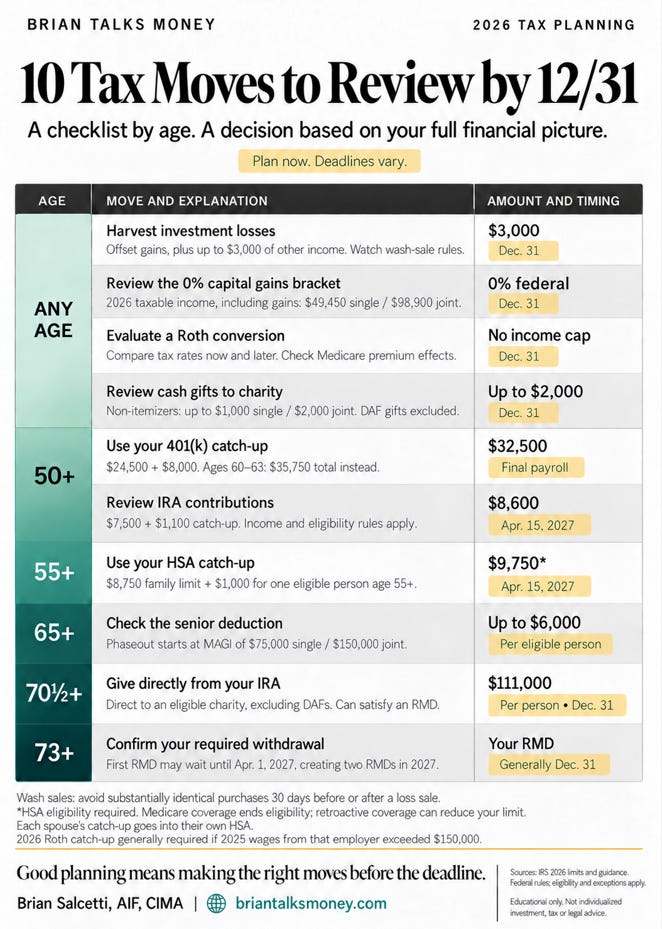
Year-end tax moves at any age:
1. Put investment losses to work.
Selling an investment at a loss can offset realized capital gains. If losses exceed gains, you can generally use up to $3,000 against other income and carry unused losses forward.
For example, $40,000 of realized gains and $25,000 of realized losses generally leave $15,000 of net gains.
Watch the wash-sale rule. Buying substantially identical securities within 30 days before or after the loss sale can disallow the current deduction. Check automatic purchases and other accounts, too.
2. Don’t overlook the 0% capital gains bracket.
A lower-income year can create an opportunity to sell appreciated investments without paying federal tax on some or all of the long-term gain.
For 2026, the 0% bracket extends to taxable income of $49,450 for single filers and $98,900 for married couples filing jointly. The gains themselves count toward those thresholds.
That can be useful after retirement, during a career break or in a year with unusually low income. State taxes may still apply.
3. Evaluate a Roth conversion before choosing an amount.
A conversion moves money from a traditional retirement account into a Roth, with the taxable portion added to this year’s income.
The question is whether paying tax now improves your longer-term outcome.
Lower-income years between retirement and required withdrawals often deserve a look. But a conversion can also affect deductions and future Medicare premiums.
For 2026, the state and local tax deduction cap is $40,400 and begins shrinking above $505,000 of modified adjusted gross income. Different amounts apply to married taxpayers filing separately.
That means a conversion’s cost can include both the tax on the conversion and a deduction you lose along the way.
4. Review how you give to charity.
Starting in 2026, eligible people who don’t itemize can deduct qualifying cash gifts of up to $1,000, or $2,000 for married couples filing jointly. Donor-advised fund gifts don’t qualify.
For readers who itemize, another change may matter more: charitable contributions are generally deductible only above 0.5% of adjusted gross income.
At $600,000 of AGI, that creates a $3,000 floor. A $20,000 eligible gift generally leaves a $17,000 deduction before other limits.
Consider whether combining several years of giving or donating appreciated investments would better support your charitable plans.
At 50 and beyond, check your contribution room
5. Review your remaining 401(k) contributions.
For 2026, the employee contribution limit is $24,500. Eligible participants age 50 and older can generally add $8,000, bringing the total to $32,500.
For those turning 60 through 63 during the year, the higher catch-up brings the total to $35,750.
Check your year-to-date contributions while there are still paychecks left. If your 2025 wages from that employer exceeded $150,000, your 2026 catch-up generally must go into Roth.
6. Review your IRA contribution options.
The 2026 IRA limit is $7,500, plus a $1,100 catch-up for those age 50 and older.
You generally have until April 15, 2027, to contribute for 2026. Eligibility, deductibility and direct Roth contribution limits depend on your circumstances.
For higher earners considering a backdoor Roth, review existing pretax IRA balances first.
7. At 55, remember the HSA catch-up.
For eligible people with family coverage, the 2026 HSA contribution limit is $8,750. One eligible person age 55 or older can add $1,000.
If both spouses qualify for catch-ups, each spouse’s additional contribution must go into their own HSA.
Medicare coverage ends HSA eligibility, and retroactive coverage can reduce the contribution limit. Review the timing before enrolling.
In retirement, coordinate income and withdrawals
8. At 65, check the senior deduction.
Eligible taxpayers age 65 and older may qualify for an additional deduction of up to $6,000 each.
It begins phasing out above modified adjusted gross income of $75,000 for single filers or $150,000 for joint filers.
A larger withdrawal or conversion can reduce that deduction. Include the effect when comparing your options.
9. At 70½, consider giving directly from your IRA.
A qualified charitable distribution, or QCD, transfers money directly from an IRA to an eligible charity.
The 2026 limit is $111,000 per person. A qualifying distribution is excluded from taxable income and can satisfy an RMD when one is due. Donor-advised funds are excluded.
If you already give to charity, review this before taking your remaining IRA withdrawals.
10. Confirm your required withdrawals.
For someone turning 73 in 2026, the first RMD can generally wait until April 1, 2027.
But delaying means taking both the first and second RMDs in 2027. That could create a larger tax bill or affect income-based benefits and premiums.
Compare both years before deciding. Inherited accounts have separate rules, so check those independently.
Before acting, put the decisions together
Consider a hypothetical couple in their early 60s. One spouse recently retired. They want to reduce a concentrated stock position, make a charitable gift and convert some IRA money to Roth.
I’d want to evaluate those decisions together.
Could appreciated shares fund the gift? How much gain would the remaining stock sale create? How much conversion income still makes sense after accounting for deductions?
Then check whether enough tax has been paid.
For many higher earners, avoiding a federal underpayment penalty generally requires timely payments covering the smaller of 90% of this year’s tax or 110% of last year’s tax. The 110% rule generally applies when prior-year AGI exceeded $150,000.
Meeting that requirement can avoid a penalty while still leaving a balance due in April.
You don’t need to complete every move on this list.
Start with the ones that fit your life, calculate their combined effect and leave enough time to get them done.
Good planning often comes down to making a handful of thoughtful decisions while you still have the opportunity.
Want help deciding which year-end tax moves fit your situation? Let’s talk.
--
Federal tax rules for 2026. Educational information only, not individualized investment, tax or legal advice. Eligibility, exceptions and state rules apply. Consult your tax adviser before acting.