
You could beat the stock market every year for 20 years and still finish behind someone who consistently underperformed it.
It sounds wrong. But the historical numbers show how it can happen.
Imagine two investors, each starting with $100,000.
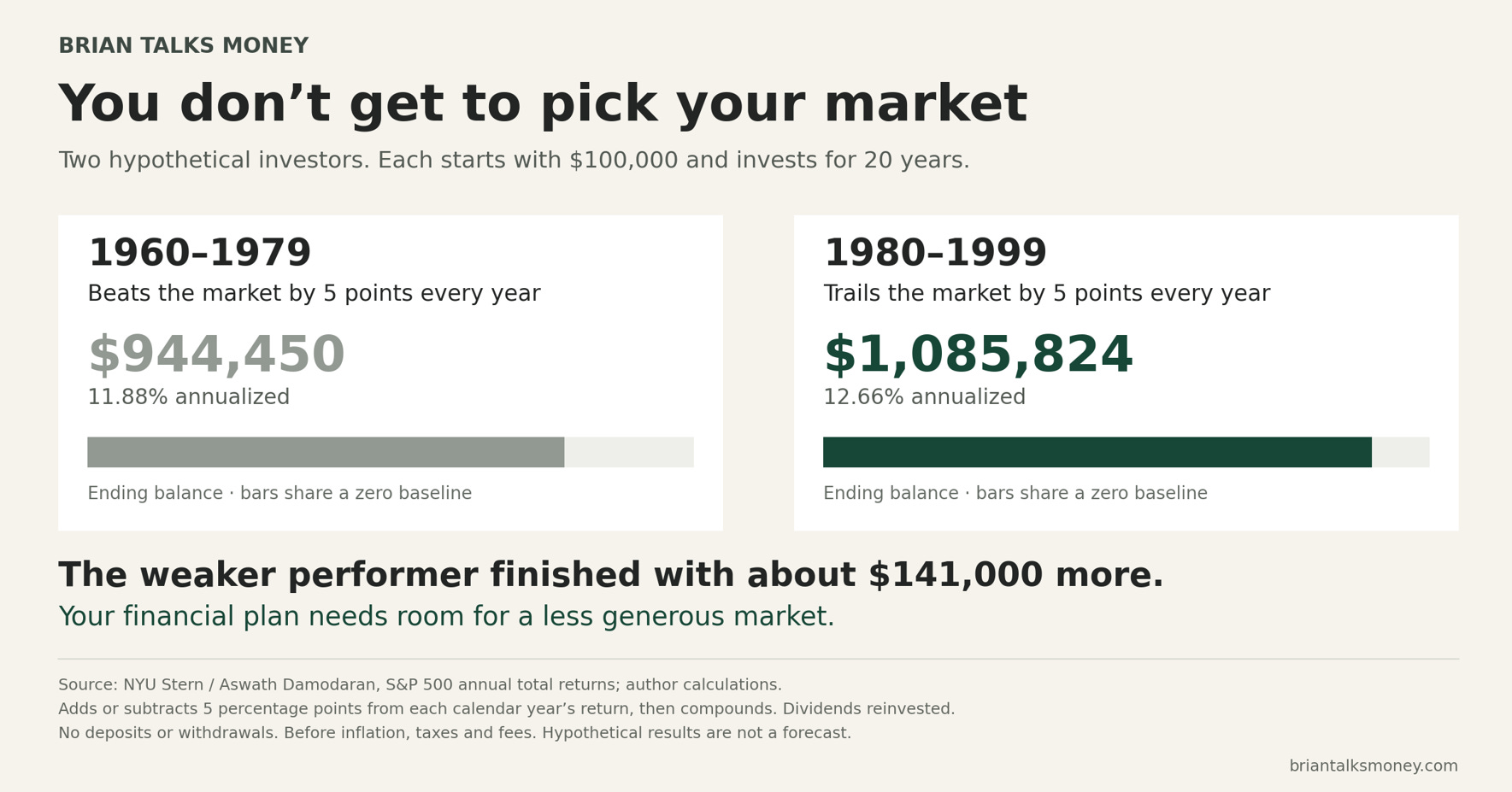
Investor A: 1960–1979
Beats the S&P 500 by five percentage points every year
Makes no additional deposits or withdrawals
Finishes with approximately $944,450
That would be an extraordinary investing record.
Investor B: 1980–1999
Trails the S&P 500 by five percentage points every year
Makes no additional deposits or withdrawals
Finishes with approximately $1,085,824
The investor who consistently trailed their market finished with about $141,000 more.
The explanation is the market itself.
Including dividends, the S&P 500 returned approximately:
6.8% annually from 1960–1979
17.7% annually from 1980–1999
Those second 20 years were exceptionally strong, ending just before the dot-com bust. That’s historical context, not a return investors should expect.
The second investor’s market was generous enough to overcome a remarkable difference in investment performance.
Skill matters. But so does the environment in which you invest.
Your investment experience shapes your return expectations
Someone who starts investing during a strong market may grow comfortable taking risks. Someone who watches years of savings disappear in a downturn may remain cautious long after markets recover.
Both have reasons for how they feel. Neither experience tells them what comes next.
That becomes especially important when retirement is approaching.
Consider a couple who has saved diligently and is deciding whether they can stop working. Their portfolio has grown, and retirement looks affordable.
Before they make that decision, I’d want to work through a few questions:
What if the next decade delivers lower returns?
What if stocks fall just as withdrawals begin?
Which expenses could they reduce?
Which bills would still need to be paid?
The answers matter more than another decimal point in a return forecast.
What would you change in a weaker market?
These questions lead to decisions people actually face:
The mortgage: Would paying it off reduce pressure on retirement income, or use too much accessible cash?
The second home: Does it fit comfortably, including maintenance, taxes and insurance?
Helping the kids: How much support can you commit to without compromising your own needs?
The retirement date: Would another year of earnings and savings meaningfully improve your position?
A strong market can make every option feel affordable. A useful plan checks whether those choices still work when returns disappoint.
For someone still building wealth, the principle applies too. If a goal depends on strong returns, there are other ways to improve the odds:
Save more toward it.
Give yourself more time.
Adjust the amount you’ll need.
Those choices may be less exciting than finding the next winning investment. They’re also more within your control.
The historical example isn’t a reason to sit in cash or try to predict the next great market. These periods are easy to identify with hindsight.
It’s a reminder to be careful about how much credit we give ourselves during good markets, and how much we ask future returns to do for us.
You don’t get to choose the market you retire into. You can choose how much your retirement depends on it.
Would your retirement plan still work with lower returns?
Your retirement deserves more than an assumption about market returns.
→ Let’s talk about your retirement plan.
--
Source: NYU Stern, Aswath Damodaran’s S&P 500 annual return data; author calculations. Investors are hypothetical. Calculations add or subtract five percentage points from each calendar year’s total return, then compound the results. Assumes reinvested dividends, no contributions or withdrawals, and excludes inflation, taxes and fees. Selected historical periods illustrate differences in market conditions, not a forecast.